
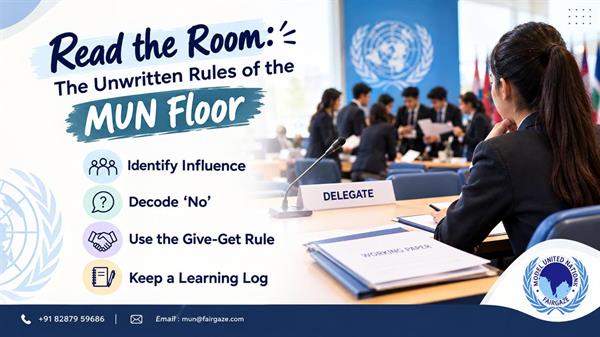
Read the Room: The Unwritten Rules of the MUN Floor
By: Vansh Tyagi, MUN Program Director
You have delivered your speech intelligently. Your arguments are researched, your facts are accurate, and your position is clear to the dais. Aftermath to all of this, when the unmoderated caucus begins, another delegate gathers twelve people around their working paper or motion while you are left trying to convince the first person who walks past. What happened in this posse? You may have won the debate—but you failed to read the room.
Model United Nations is often treated as a competition of speeches, but the real work begins when the microphones are off. The United Nations itself describes negotiation as a process of understanding different concerns, narrowing disagreements and gradually developing language that multiple delegations can accept. The first skill, therefore, is not speaking. It is observing. Let’s decode the solution: what and who has influence in the room? Perhaps, during an unmoderated caucus, look around. Which delegate are other delegates repeatedly consulting? Whose suggestions appear in the working paper? Who is connecting two groups that initially disagreed? These are the delegates who influence the room. Prior to approaching a potential bloc, spend a few minutes identifying its informal leaders. Your objective should not simply be to find the largest group; it should be to understand who can move that group and persuade them in your thoughts. Secondly, we ought to learn to decode ‘No’ as one of the most useful negotiation habits is refusing to treat every rejection as final. When another delegation says, “We cannot support this,” don't immediately start defending your clause. Ask them that:
“Is your concern with the principle, the wording, or the implementation?”
A disagreement with the principle may require a different approach. A disagreement with the wording may require an amendment. A disagreement with implementation may be solved by changing the mechanism. One sentence said diplomatically can turn a dead end into a negotiation for you. Third, use the Give-Get Rule: if, for instance, you are removing some clause due to some delegates’ suggestion, then in return you should ask for something like, ‘If we remove that clause, would your delegation support the implementation mechanism? It will promote the sense of reciprocity. To keep your learning book, have a page after each committee session is concluded; ask yourself three questions:
Who did I convince?
Who did I understand better?
Who would work with me again?
Related Blogs
-
_200.png)
12-Oct-2026 Building an Argument: Assertive vs Aggressive
-

12-Oct-2026 From Conflict to Consensus: Practical Negotiation Methods for Delegates
-

12-Oct-2026 Read the Room: The Unwritten Rules of the MUN Floor
-
_200.jpeg)
12-Oct-2026 90 Seconds to Make Your Case
-
26-Jun-2026 Crafting a Powerful GSL Speech for the Model United Nations
-
19-Jan-2026 How to Prepare for Your First MUN?
-

24-Dec-2025 Top Nearby MUN Conferences for Students to Join
-

27-Nov-2025 Global Voices Assemble India Next Big MUN Conference